Interview with Peggy Bejas, Head of Logistics Planning and Support Projects at DocMorris
02.11.2026
DocMorris offers specialized courses for its logistics employees to help them further develop their professional expertise. This also allows the company to provide targeted support to people facing barriers to entering the job market.
Editorial Team: How do you support your logistics employees?
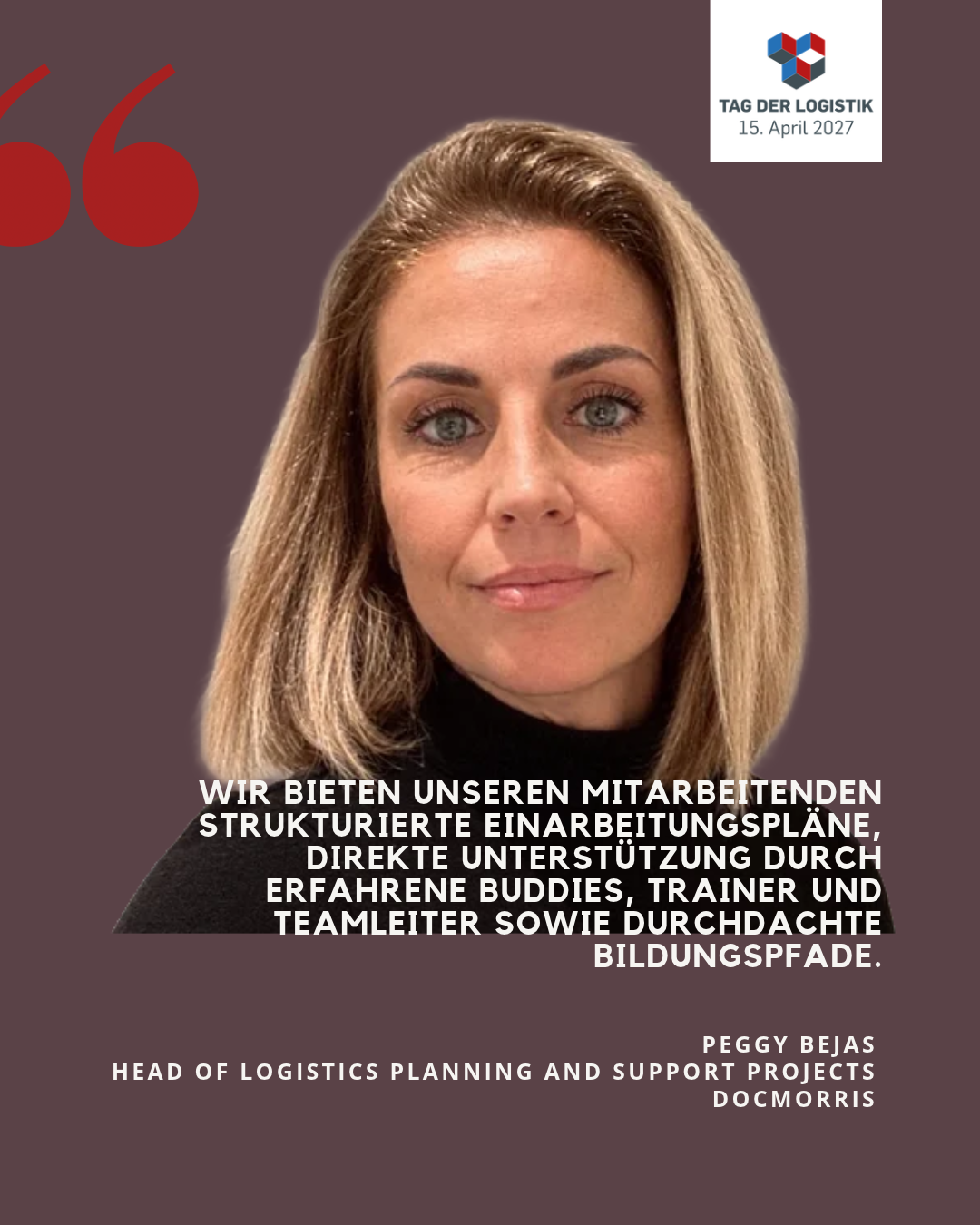
Peggy Bejas: In our logistics division, we focus on holistic development, because growth begins with being given opportunities – and flourishes when we work together to seize and expand those opportunities. We offer our employees structured onboarding plans, direct support from experienced mentors, trainers, and team leaders, as well as well-designed training pathways.
Through our internal Warehouse Academy, we facilitate continuous professional development: The spectrum ranges from MBO1 training programs for refugees, through MBO2 certifications for qualified logistics employees, to MBO3 qualifications for experienced logistics employees and supervisors. (In the Netherlands, MBO1 training is comparable to training to become a logistics employee, and MBO2 to training to become a warehouse specialist.) Our goal is to offer all employees sustainable career prospects and genuine opportunities for advancement.
Editorial Team: How do you decide which training path is right for each employee? Is there a way to tailor the training to individual needs?
Peggy Bejas: The decision is highly individualized and made through close collaboration between employees, our team leaders, and specialized coaches. We carefully assess existing qualifications, prior knowledge, and language skills. Through day-to-day support, our team leaders and coaches quickly identify potential: Some new colleagues master operational processes after just a few days but may still need support with technical terminology, for example. Based on this, we flexibly tailor our support. Our MBO training paths (MBO1, MBO2, or MBO3) combine on-the-job training with language support and enable employees to earn a recognized vocational degree directly at our location in Heerlen.
Editorial Team: What role does continuing education play in helping people who face barriers to entering the labor market?
Peggy Bejas: A crucial role. We see training as a bridge between untapped potential and the demands of the job market. Many people – such as refugees or those who are further removed from the job market – are extremely motivated but face obstacles like a lack of specialized knowledge or insufficient recognition of their previous qualifications. When you give them a real chance and actively help them gain the necessary skills, amazing success stories emerge. In this context, continuing education isn’t just about professional development – it’s the most important driver of social integration, independence, and long-term self-confidence.
Editorial Team: You also have a program for asylum seekers. Please tell us more about it.
Peggy Bejas: I’d be happy to! This is our regional project, which we carry out together with our partners. From the very beginning, the project combines paid work in our logistics department with targeted Dutch language instruction in small groups at the Beyond Language Campus. As DocMorris, we launched this initiative in May 2025 as pioneers with two asylum seekers to test this model in medical logistics. What began as a pilot project has turned into a real success story: Twenty people are now participating in our program. Ten of them have even been able to transition into direct employment at DocMorris.
This is a close collaboration within the regional beyond-medtech network. In medical logistics, qualified candidates from all target groups are given an opportunity; among asylum seekers, we observe a particularly high level of motivation. As soon as the relevant residency requirements are met, participants can enroll in the Beyond MBO1 program and continue their vocational training in a targeted manner.
Editorial Team: You mentioned language instruction. What support services are available beyond purely technical training – for example, for language or personal challenges?
Peggy Bejas: That’s right; the support is by no means limited to technical knowledge. For language skills, we offer practical instruction in small groups. On the shop floor, dedicated buddies and team leaders are on hand to ensure a close-knit and supportive onboarding experience. In addition, we work closely with the social coaches and follow-up coaches at WSP Parkstad, who also provide support with personal issues, scheduling work hours, or finding transportation solutions. This strong network combining on-the-job training and social support ensures that our employees feel supported from day one and can progress step by step.
Editorial Team: Thank you very much for the interview and your insights.